Privacy-Preserving Voting Systems: Why Institutions Are Adopting Them.

Wasiu Ajao
Dec 24, 2025•3 min read
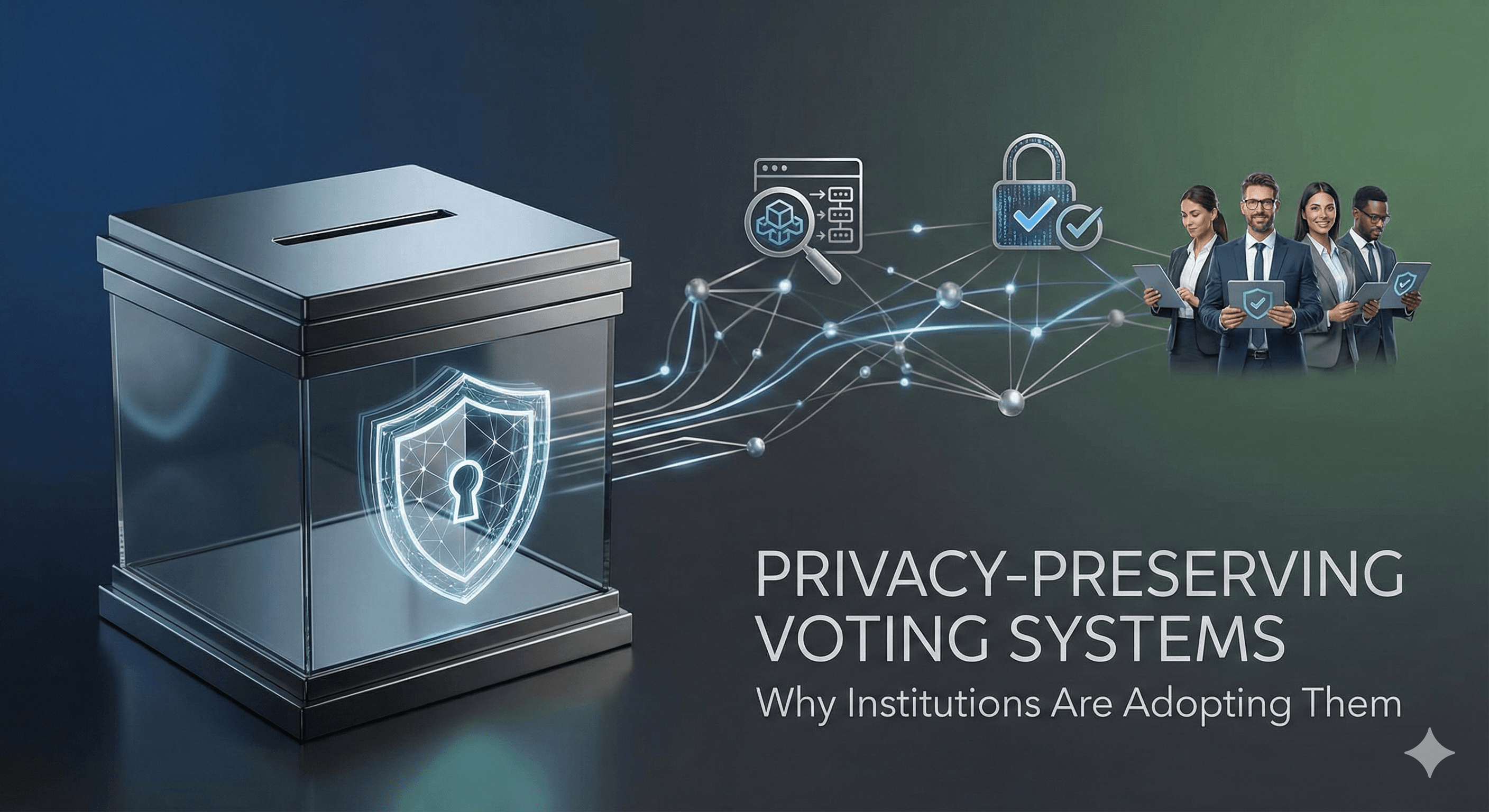
In an era where digital privacy concerns dominate headlines, institutions worldwide are recognizing the critical importance of privacy-preserving voting systems. Traditional voting methods, whether paper-based or early digital implementations, often struggle to balance transparency with voter anonymity. Modern cryptographic techniques have revolutionized how we approach this challenge. Zero-knowledge proofs, homomorphic encryption, and verifiable computation allow us to verify election integrity without compromising individual privacy—a breakthrough that seemed impossible just decades ago.
The Rise of Privacy-Preserving Technology
Universities, professional organizations, and corporate boards are leading the adoption of privacy-preserving voting systems for several compelling reasons. The technology has matured from theoretical concepts to production-ready systems that organizations trust with their most important decisions. These systems provide mathematical guarantees that were previously impossible. Voters can verify their participation without revealing their choices, election observers can confirm the integrity of the count without accessing individual ballots, and administrators can prove the system operates correctly without having the power to manipulate results.
Why Institutions Are Making the Switch
Verifiable Integrity
Stakeholders can independently verify that their vote was counted correctly without revealing how they voted. This mathematical certainty builds trust in ways traditional systems cannot match. Each voter receives cryptographic proof of their participation, which can be verified against the public record.
Enhanced Participation
Remote voting with strong security guarantees enables broader participation, particularly important for global organizations and distributed teams. Members can participate from anywhere in the world without compromising the security or privacy of their votes.
Audit Trails Without Compromise
Complete transparency in the process coexists with complete privacy in the outcome—a combination previously thought impossible. Every step of the election can be audited and verified, while individual voter choices remain completely private.
The Technical Foundation
At VeraVote, we implement multiple layers of cryptographic protection. Each vote is encrypted end-to-end, with verification proofs generated at every step. Voters receive a unique receipt that proves their participation without revealing their choice. The system employs threshold cryptography, meaning no single entity can decrypt results. Only when a predetermined number of independent trustees collaborate can the final tally be revealed—ensuring that even system administrators cannot compromise voter privacy. This architecture provides defense in depth. Even if one component is compromised, the overall system maintains its security guarantees. The cryptographic protocols have been peer-reviewed and tested in real-world elections, demonstrating their robustness against sophisticated attacks.
Real-World Impact
Organizations implementing privacy-preserving voting systems report significant improvements in voter confidence and participation rates. When people trust that their votes are both private and accurately counted, they're more likely to participate in the democratic process. Beyond participation, these systems reduce the administrative burden of running elections. Automated cryptographic verification replaces manual auditing processes, while still providing stronger security guarantees. The result is elections that are simultaneously more secure, more transparent, and less expensive to administer.
Looking Forward
As institutions increasingly demand both security and privacy, the adoption of privacy-preserving voting systems will only accelerate. The technology has matured from academic research to production-ready systems trusted by organizations worldwide. The future of democratic processes—whether in governance, corporate decision-making, or community organizing—depends on systems that respect both the integrity of the process and the privacy of participants. Privacy-preserving voting systems represent not just a technological advancement, but a fundamental shift in how we approach collective decision-making in the digital age. The question is no longer whether organizations will adopt these systems, but how quickly they can be implemented to meet the growing demand for secure, transparent, and privacy-respecting democratic processes.